Deposits on the paper machine: a problem that starts small and ends in lost productivity
Why controlling deposit formation is more efficient than simply removing deposits after the problem appears.
Translation of the original article in Portuguese.
Why controlling deposit formation is more efficient than simply removing deposits after the problem appears.
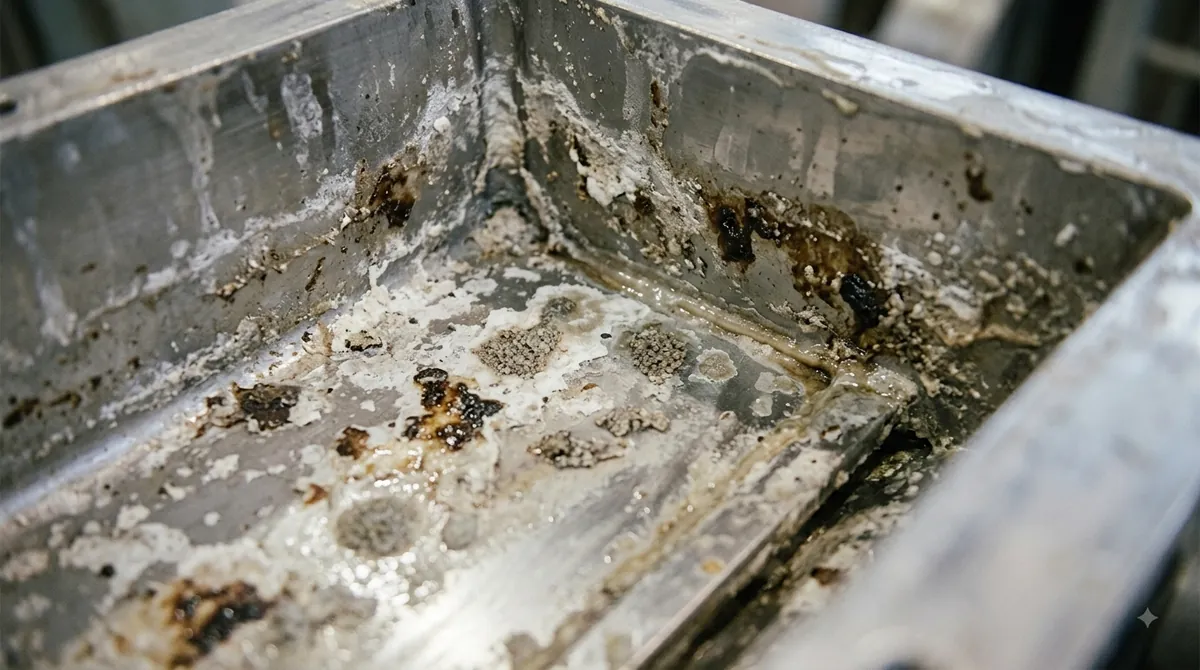
On a paper machine, deposits rarely appear suddenly. Most of the time, the problem starts with small amounts of contaminants that remain dispersed in the process, circulate through the system and, under certain conditions, begin to agglomerate and adhere to surfaces.
Pitch, stickies, hot melts, paraffins and other contaminants may be present in the raw material or be introduced along the process. In systems that use recycled fibers, for example, adhesives and coating materials present in recovered paper can contribute to the formation of sticky contaminants. At the same time, increasingly closed water circuits favor the accumulation of dissolved and colloidal substances, making control more complex.
The problem is that these contaminants do not need to be visible at first to start affecting the operation.
When these particles become destabilized or agglomerate, they can deposit on fabrics, felts, rolls, headboxes and other machine surfaces. As deposits build up, changes in permeability, drainage and sheet transfer may appear, along with a greater need for cleaning interventions. In more severe cases, deposits can contribute to sheet breaks, paper defects, reduced speed and unscheduled downtime.
Deposit control is not the same as cleaning
That is why deposit control should not simply be confused with cleaning.
Cleaning acts on a deposit that has already formed. Chemical control, on the other hand, can act earlier, interfering with the properties and behavior of the contaminant within the process.
Depending on the nature of the deposit and the characteristics of the machine, different mechanisms can be used. Dispersants keep contaminants in a dispersed state, reducing their tendency to agglomerate. Detackifiers modify the surface characteristics of sticky materials, reducing their tendency to adhere to surfaces. Microfixatives, in turn, can fix finely dispersed contaminants to the fibers, reducing their presence in the colloidal phase and their availability to form new deposits.
Technical literature shows that different control mechanisms can perform differently depending on the type of pitch or stickies and on process conditions, which reinforces the importance of choosing the chemical strategy according to the origin and behavior of the contaminant.
From removal to control
This change of approach is particularly important because the deposit that shows up on a fabric, felt or roll may be only the most visible part of a problem that is building up along the circuit.
An efficient program should therefore consider not only where the deposit is, but also where it comes from, how it behaves in the process and under which conditions it tends to become depositable.
The DISAWET line
This is the concept behind the DISAWET line by Disamtex Chemicals & Additives.
The line was developed to act on different mechanisms related to contaminant and deposit control in papermaking, using dispersion, detackification and microfixation technologies, as well as solutions for conditioning and cleaning process surfaces.
More than simply removing a deposit that has already formed, the goal is to work on the behavior of the contaminant, seeking to reduce its tendency to agglomerate and deposit and, consequently, to contribute to greater operational stability.
This approach allows the treatment to be tailored to the specific characteristics of each process, considering raw material, water circuit, type of contaminant, deposition site and machine operating conditions.
After all, in papermaking the cost of a deposit is not only the product used to remove it. It is also the cleaning, the lost machine time, the interventions, the reduced speed and, above all, the impact that instability can have on productivity and quality.
Controlling deposits is, therefore, much more than keeping the machine clean. It means preserving the conditions the machine needs to keep producing with stability, efficiency and predictability.
With this vision, Disamtex develops the DISAWET line, offering chemical solutions for contaminant and deposit control and contributing to a more stable and efficient operation in the paper industry.
Technical authorPeter Evandro Haake, chemical engineer | Pulp & Paper